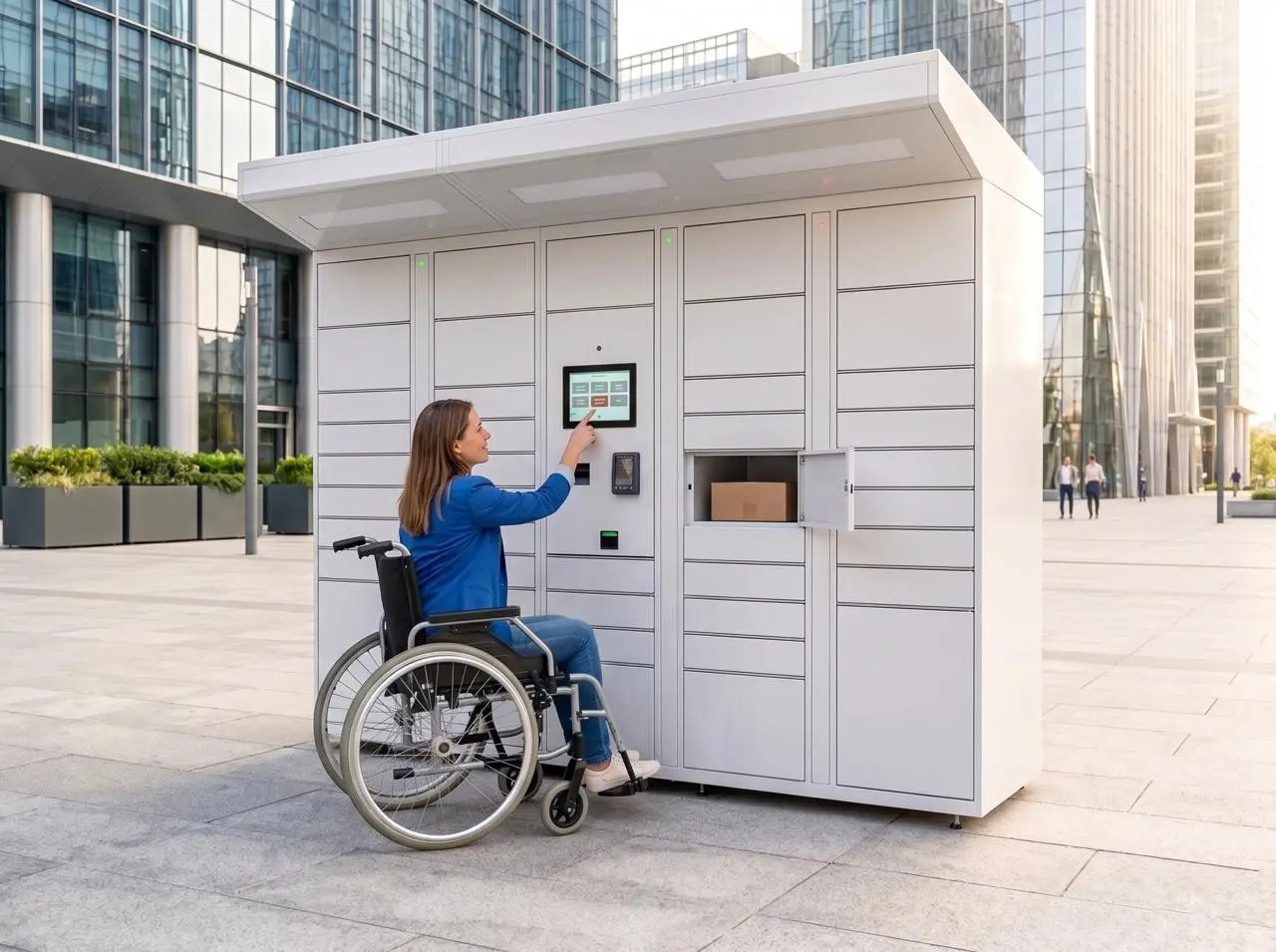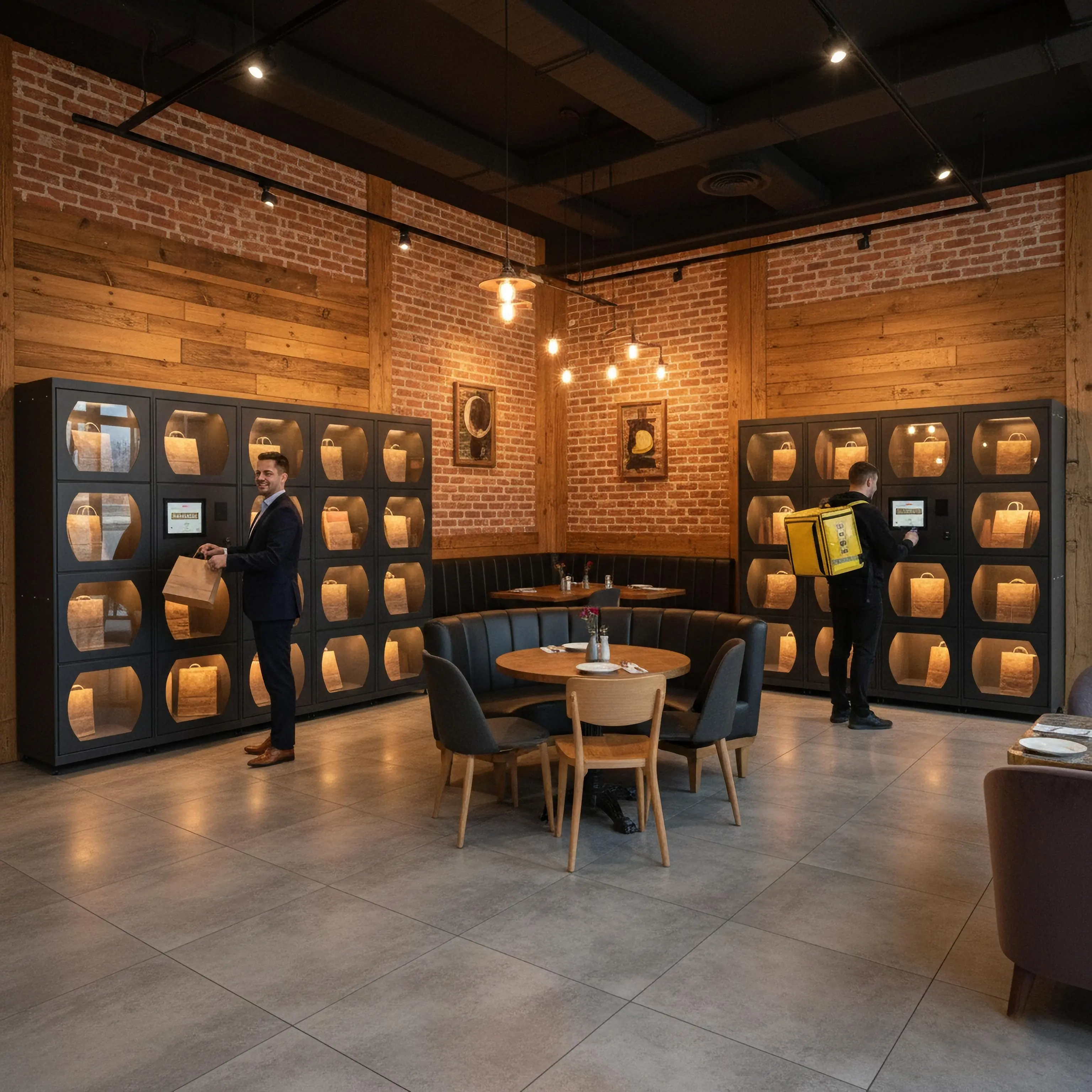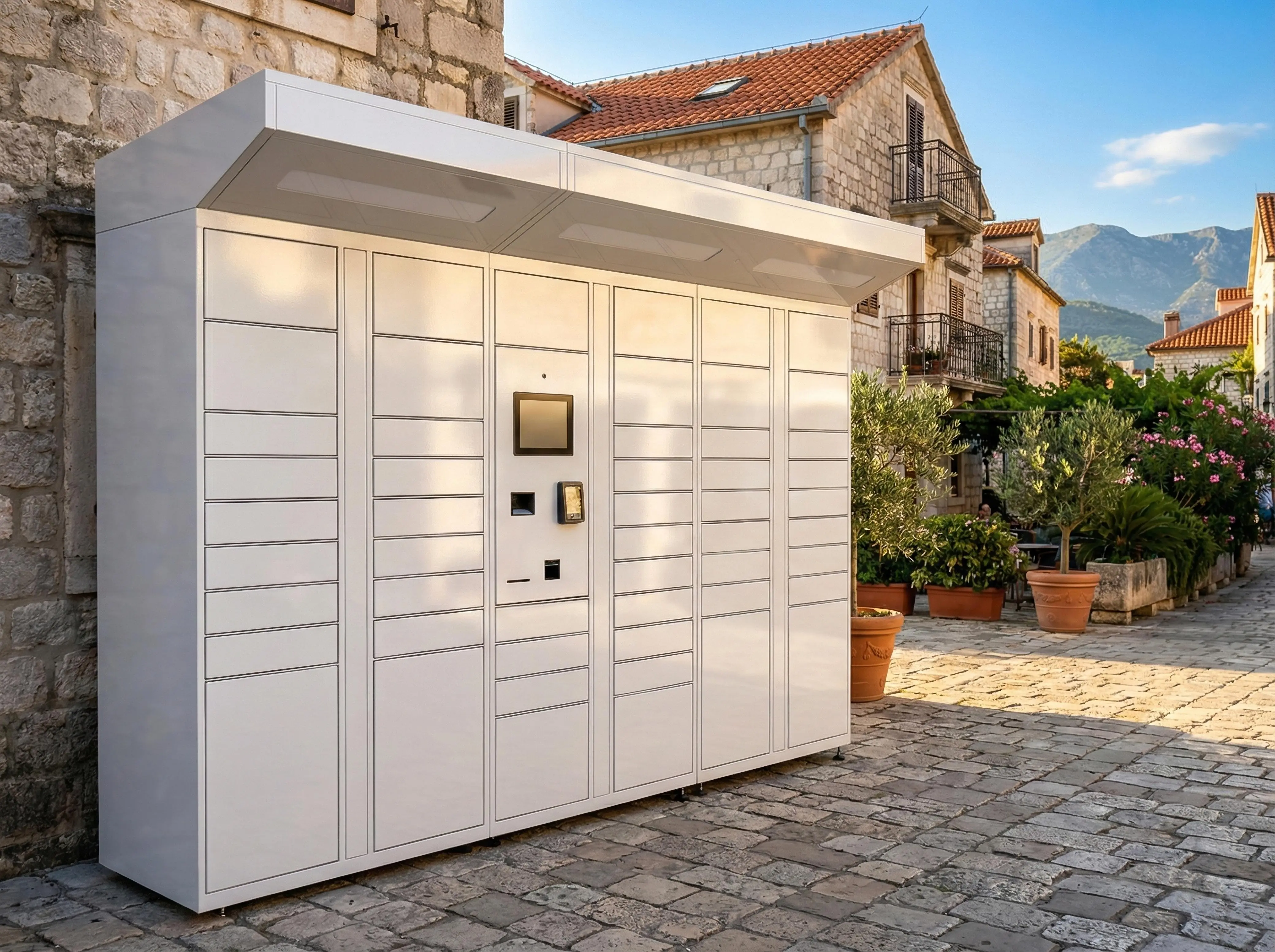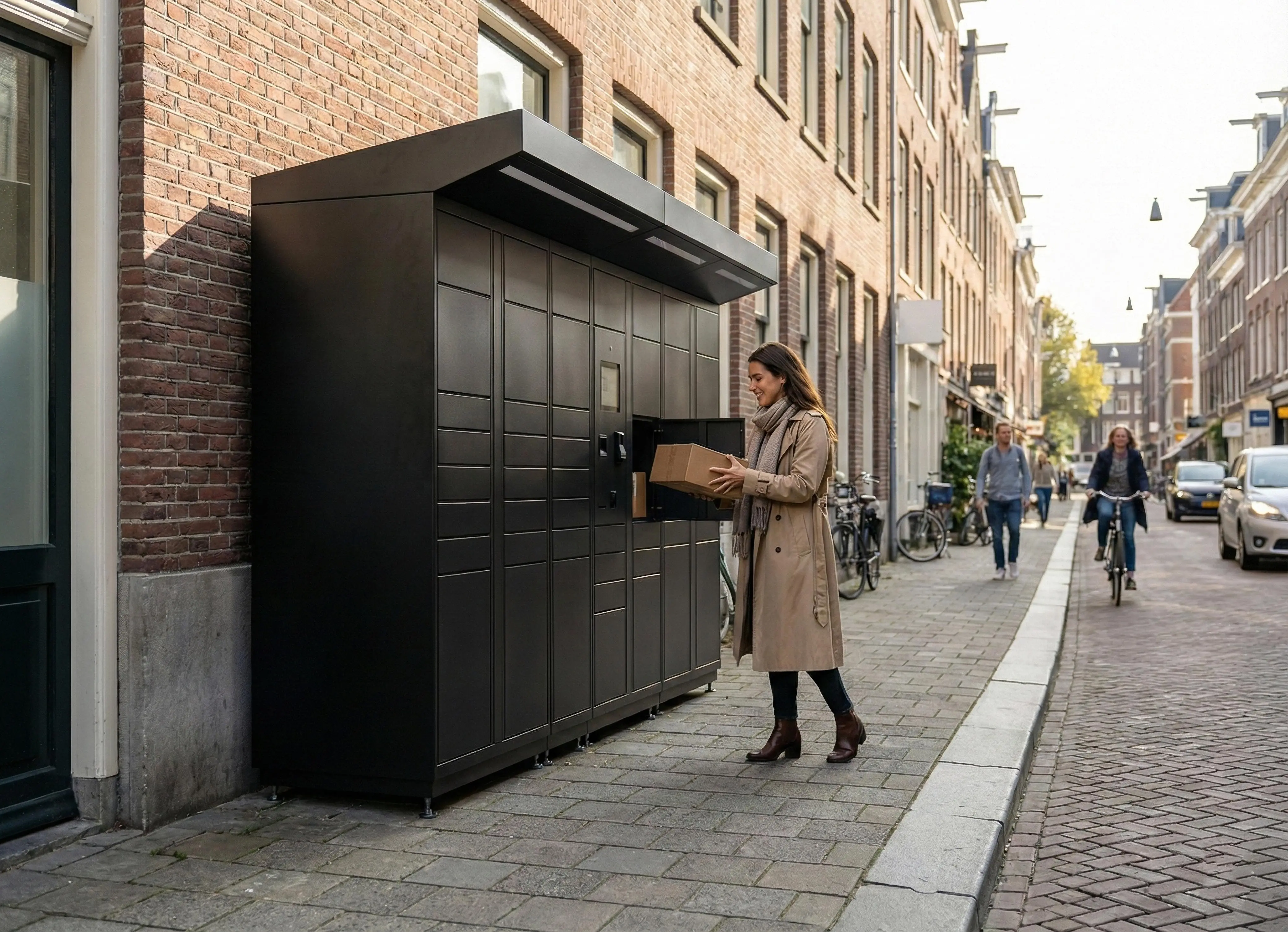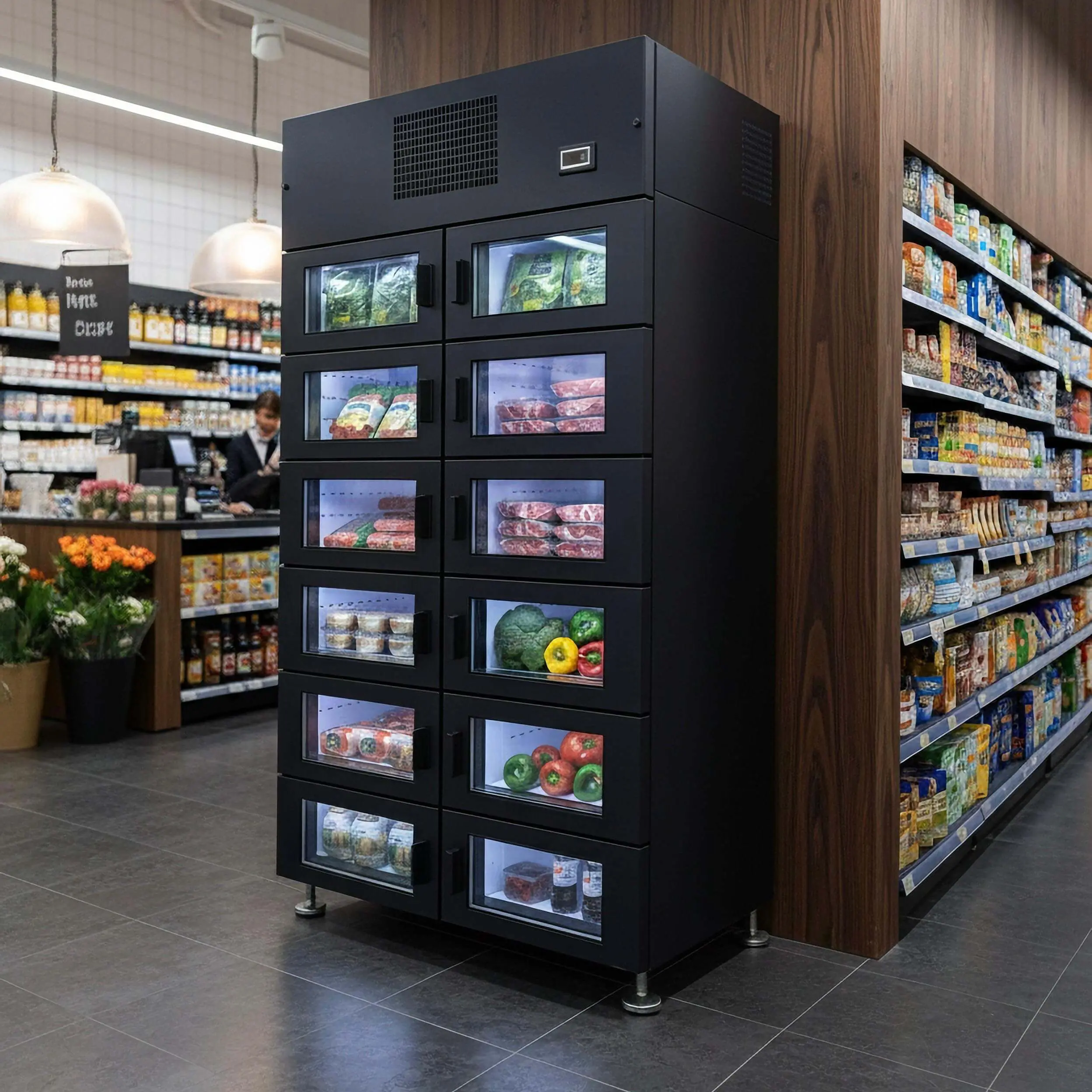
A grocery delivery arrives at 14:00. The customer is at work until 18:00. By the time they return home, the milk is warm, the produce is wilting, and dinner plans are ruined. This scenario repeats across 15-25% of cold chain deliveries, costing retailers €15-25 per failed attempt before accounting for spoiled inventory and damaged customer relationships.
Temperature-controlled lockers eliminate this coordination problem entirely. These refrigerated lockers maintain precise 2-8°C cooling for fresh products or -18 to -25°C for frozen goods, enabling 24/7 secure pickup without scheduling constraints. Smart lockers with temperature control decouple delivery timing from customer availability, preserving cold chain integrity for 24-48 hours while slashing failed delivery rates by 75-80%.
The cold storage locker market reached €1.9 billion in 2024 and projects €3.1 billion by 2031, driven by e-commerce grocery expansion and pharmaceutical digitalization. This guide covers technical specifications, regulatory compliance, total cost economics, and implementation strategies for freezer lockers and refrigerated parcel lockers across retail, healthcare, and logistics sectors.
Quick Facts: Temperature-Controlled Lockers Explained
Automated cold storage units integrating refrigeration, IoT monitoring, and secure access control maintain 2°C to -25°C for perishable goods during last-mile delivery and customer pickup, eliminating failed delivery coordination challenges.
Refrigerated lockers operating at 2-8°C serve fresh produce, dairy, prepared meals, and most pharmaceuticals - consuming 3-5 kWh/day while maintaining FDA-compliant cold chain standards for 24-48 hour storage windows.
Freezer lockers maintaining -18 to -25°C handle frozen foods, ice cream, and specialized medical specimens - requiring 6-10 kWh/day and 40-60% higher capital investment due to enhanced insulation and more powerful compressor systems.
Major retail deployments validate market adoption: Walmart operates 500+ pickup locker installations, while Whole Foods locations with locker systems report 11% increases in micro-visits compared to stores without automated pickup infrastructure.
FDA Food Code and EU regulations mandate compliance: FDA requirements specify ≤5°C for refrigerated storage and ≤-18°C for frozen, while EU Regulation 37/2005 enforces cold chain documentation with continuous temperature logging, automated alerts, and exportable audit trails.
Documented business impact drives ROI: Implementations achieve 75-80% reduction in failed deliveries, 50-65% labor cost savings through automated pickup, and 35-45% transportation emissions reduction via consolidated delivery routing - typical payback within 18-24 months.
Capital investment ranges from €7,000 to €70,000+ per unit, depending on capacity (6-12 compartments entry-level, 24+ pharmaceutical-grade), temperature capabilities (refrigerated vs freezer vs multi-zone), and compliance features (basic monitoring vs full FDA 21 CFR Part 11 validation).
Energy efficiency technologies reduce operating costs: Variable-speed compressors cut consumption by 30-40% compared to fixed-speed units, while smart defrost cycles reduce freezer energy use by 15-20% - proper sizing and insulation quality critically impact long-term operational expenses.
Social sector deployment proves versatility: Mid-Ohio Food Collective deployed 72 refrigerated lockers for food assistance programs, achieving full utilization within days while dramatically improving fresh food access in underserved rural communities throughout Ohio.
Economic viability threshold starts at 15-25 daily orders for positive ROI through failed delivery elimination and labor savings; high-volume locations processing 40+ orders achieve 12-15 month payback periods through operational efficiency gains.
Understanding Temperature-Controlled Locker Systems
What Temperature-Controlled Lockers Are
Temperature-controlled lockers are automated storage units combining commercial-grade refrigeration equipment, real-time IoT monitoring systems, and secure electronic access control to maintain precise temperature ranges between 2°C and -25°C. Unlike passive insulated containers relying on ice packs or dry ice with gradual temperature degradation, these refrigerated parcel lockers use active cooling systems that continuously regulate internal conditions regardless of external ambient temperatures.
The fundamental architecture integrates four critical subsystems working in coordination. Commercial refrigeration units (compressor-based or thermoelectric) provide active cooling capacity. Temperature sensors with IoT connectivity monitor conditions every 1-5 minutes, transmitting data to cloud platforms. Electronic locking mechanisms integrate with authentication systems (PIN codes, QR codes, mobile apps) for secure compartment access. Cloud-based management software coordinates the entire operation - from delivery notifications to predictive maintenance alerts - enabling remote monitoring without on-site personnel requirements.
This integration separates reliable cold chain lockers from standard parcel lockers retrofitted with basic cooling. Proper system design ensures cold chain integrity remains unbroken from warehouse storage through last-mile delivery to customer retrieval, meeting regulatory requirements for food safety and pharmaceutical compliance.
Key Technologies & Components
The thermal envelope forms the foundation of any temperature locker system. High-density polyurethane foam insulation (75-100mm for refrigerated applications, 100-150mm for freezer capabilities) creates the thermal barrier, maintaining efficiency even in extreme outdoor conditions. Advanced installations specify vacuum-insulated panels (VIPs), achieving equivalent thermal performance with 40% less thickness - valuable for space-constrained urban deployments where every cubic centimeter affects capacity.
Cooling systems vary by application requirements and operational priorities. Compressor-based refrigeration delivers powerful, consistent cooling capable of reaching -25°C, making these systems essential for freezer lockers and high-capacity installations. Compressors with variable-speed drives reduce energy consumption by 30-40% compared to fixed-speed units by modulating output to match actual cooling loads rather than cycling on-off. Thermoelectric (Peltier) cooling systems offer silent operation and minimal maintenance for smaller refrigerated lockers handling only fresh products, though these systems cannot achieve deep freezing temperatures below -10°C.
IoT monitoring represents the intelligence layer, enabling compliance and operational efficiency. Temperature sensors in each compartment log readings every 1-5 minutes, creating continuous audit trails required by FDA and EU regulations. Cloud platforms analyze this data stream using predictive algorithms that identify patterns indicating potential equipment issues - gradual temperature drift, extended compressor runtime, slow recovery after door openings - triggering maintenance notifications 2-3 weeks before component failures occur. This proactive approach prevents costly downtime and product loss while ensuring 99.7%+ temperature compliance rates.
Cloud management platforms provide the operational backbone for smart lockers with temperature control. REST API integrations connect locker systems bidirectionally with order management platforms, inventory databases, customer notification services, and payment processors. Hardware-agnostic parcel locker software like CYBER HIVE™ enables businesses to manage mixed equipment from multiple manufacturers through unified interfaces. When orders are deposited, systems automatically assign compartments based on temperature requirements, generate secure access codes, and trigger pickup notifications - all without manual intervention. Remote monitoring dashboards provide real-time visibility into temperature compliance, compartment utilization, energy consumption, and maintenance needs across single locations or distributed networks spanning multiple cities.
Temperature Ranges: Refrigerated vs Freezer Systems
Refrigerated Lockers (2-8°C)
Refrigerated locker systems operating within 2-8°C temperature ranges serve the broadest spectrum of cold chain applications. Fresh produce maintains optimal quality within this range - leafy greens, berries, and vegetables retain cellular structure and nutritional value for 24-48 hours. Dairy products, including milk, yogurt, and cheese, remain safe and fresh. Prepared meals from meal delivery services stay within food safety guidelines. Most pharmaceutical products, including insulin, vaccines, and biologics, require strict 2-8°C storage with minimal excursion tolerance.
Energy consumption for 2°C lockers averages 3-5 kWh per day per cubic meter of storage capacity, varying based on ambient conditions, door opening frequency, and insulation quality. A typical 12-compartment unit in moderate climates consumes €45-€85 monthly in electricity costs at standard European rates. Equipment requirements remain relatively straightforward: standard electrical service (220-240V, 15-20A), basic compressor systems, and moisture management for condensation control.
The operational advantage of refrigerated-only configurations lies in simplicity and cost efficiency. Without defrost cycle requirements, compartments remain available 24/7 for customer pickup. Temperature recovery after door openings occurs within 10-15 minutes, enabling high-throughput operations during peak periods. For businesses handling exclusively fresh products - grocery click-and-collect operations, pharmacy prescription pickup, or restaurant meal delivery - refrigerated systems provide optimal economics without paying premiums for unnecessary freezer capability.
Freezer Lockers (-18 to -25°C)
Freezer lockers maintain -18 to -25°C and handle products requiring deep freeze storage: frozen meals, ice cream, frozen vegetables, meat and seafood, and specialized medical specimens. The greater temperature differential from ambient conditions (often 40-50°C in summer climates) demands significantly more robust engineering than refrigerated systems.
Energy consumption jumps to 6-10 kWh per day per cubic meter - roughly double refrigerated units - translating to €90-€140 monthly electricity costs for equivalent capacity. Enhanced insulation becomes critical: 100-150mm polyurethane foam versus 75-100mm for refrigerated applications. Compressor systems require 40-60% more cooling capacity to maintain target temperatures and manage thermal loads from door openings.
Defrost cycles present operational complexity absent from refrigerated systems. Ice buildup on evaporator coils reduces cooling efficiency and must be periodically removed through automated defrost sequences. Smart defrost systems running only when needed (rather than fixed schedules) reduce energy waste by 15-20%, but temporarily take compartments offline during 20-30 minute defrost periods. This affects capacity planning - businesses must account for 10-15% of freezer compartments being unavailable at any given time during defrost rotation.
Capital costs reflect this complexity: freezer locker units cost 40-60% more than equivalent refrigerated systems. Organizations evaluating outdoor parcel locker deployments in extreme climates face additional weatherproofing premiums for freezer-capable units. Organizations should deploy dedicated freezer capacity only when order volumes justify the premium - typically when frozen items represent 20%+ of daily transactions.
Multi-Zone Combination Systems
Temperature-controlled lockers offering both refrigerated and freezer compartments within single installations provide operational flexibility for businesses handling mixed product portfolios. Grocery pickup operations particularly benefit: a customer ordering fresh produce, dairy, and frozen pizza retrieves everything from one location using a single pickup code, despite items requiring different storage temperatures.
Multi-zone systems cost 25-35% more than all-refrigerated equivalents but substantially less than deploying separate refrigerated and freezer units. A combination unit with 16 refrigerated compartments and 8 freezer compartments typically costs €18,000-€24,000 - delivering better economics than separate deployments when space constraints exist. Detailed smart locker pricing configurations help organizations optimize investment based on actual operational requirements.
The critical decision factor involves analyzing actual product mix data. Industry data shows frozen items represent only 15-20% of orders in typical grocery applications. Right-sizing the freezer-to-refrigerated ratio based on actual demand patterns reduces both capital investment and ongoing energy costs by 25-30% compared to oversized freezer deployments. Organizations can apply last-mile delivery economics frameworks to calculate optimal configurations based on order volumes and product mix.
Feature Comparison: Refrigerated vs Freezer Systems
Feature | Refrigerated (2-8°C) | Freezer (-18 to -25°C) |
|---|---|---|
Energy consumption | 3-5 kWh/day/m³ | 6-10 kWh/day/m³ |
Monthly electricity cost | €45-€85 (12-comp unit) | €90-€140 (12-comp unit) |
Capital cost | Baseline | +40-60% premium |
Insulation thickness | 75-100mm polyurethane | 100-150mm polyurethane |
Defrost cycles | None required | Required (10-15% downtime) |
Temperature recovery | 10-15 minutes | 20-25 minutes |
Ideal applications | Fresh food, dairy, pharma | Frozen meals, ice cream |
Industry Applications & Regulatory Compliance
Primary Use Cases by Sector
Grocery and Retail Click-and-Collect
Refrigerated lockers have become essential infrastructure for grocery retailers responding to e-commerce demand. Multi-zone systems enable customers to order fresh produce, dairy, and frozen items in single transactions, retrieving everything from one secure location. Major retailers validate this strategic value: Walmart operates 500+ pickup locker installations, while Whole Foods locations with locker systems report 11% increases in micro-visits compared to stores without automated pickup infrastructure.
Temperature-controlled storage extends product freshness for 24-48 hours. Integration with inventory systems automatically assigns compartments based on order contents - sending customers single notifications regardless of whether orders span multiple temperature zones. Click-and-collect locker systems achieve 60-70% customer preference rates when offered alongside traditional delivery.
Pharmaceutical and Healthcare Dispensing
Pharmacy applications impose the strictest requirements for refrigerated locker deployments. Medications requiring cold chain compliance - insulin, vaccines, biologics - demand continuous 2-8°C storage with 99.7% temperature compliance. Smart lockers with temperature control enable 24/7 prescription pickup outside traditional pharmacy hours, improving medication adherence. Organizations can reference pharmacy refrigerated locker implementation guides covering compliance requirements and ROI calculations.
Food Service and Meal Delivery
Temperature lockers enable ghost kitchens and meal prep services to extend reach without driver coordination. All-refrigerated configurations (2-5°C) optimize for prepared meals with a 24-48 hour shelf life. Advanced installations use forced-air circulation, maintaining ±0.5°C uniformity across compartments. Heated smart lockers provide complementary solutions for hot food delivery.
Specialized Industrial Applications
Beyond consumer applications, temperature-controlled parcel lockers serve law enforcement (refrigerated evidence lockers), research facilities (specimen transport), and cannabis dispensaries (compliant pickup with age verification). Mid-Ohio Food Collective deployed 72 refrigerated lockers for food assistance, achieving full utilization within days while improving fresh food access in rural communities.
The unifying principle: temperature-controlled lockers solve secure, automated transfer of perishable items without requiring simultaneous presence of sender and receiver.
Application | Temperature Range | Typical Dwell Time | Key Features |
|---|---|---|---|
Grocery Pickup | Ambient/2-8°C/-18°C | 4-24 hours | Multi-zone, high capacity |
Pharmaceuticals | 2-8°C | 1-48 hours | Compliance logging, alerts |
Meal Delivery | 2-5°C | 2-48 hours | Uniform airflow, compact |
Frozen Foods | -18 to -25°C | 4-48 hours | Defrost cycles, high insulation |
Compliance & Cold Chain Standards
Essential Regulatory Requirements
FDA Food Code compliance:
Refrigerated storage: ≤5°C for potentially hazardous foods
Frozen storage: ≤-18°C with continuous documentation
Temperature logging provides maintenance throughout storage periods
EU Regulation 37/2005 mandates:
Continuous temperature logging at 1-minute intervals
Exportable compliance reports for regulatory audits
Validation protocols for pharmaceutical applications
NSF International Certification:
US-based food safety compliance validation is essential for refrigerated locker deployments
Required for grocery, meal delivery, pharmaceutical, and restaurant segments
Validates equipment design, materials, and temperature control capabilities
Third-party verification ensures systems meet stringent food safety standards
FDA 21 CFR Part 11 for pharmaceuticals:
Electronic records and signatures validation
Audit trail integrity for temperature data
Pharmaceutical-grade monitoring requirements
Temperature Excursion Protocols
Advanced temperature-controlled locker systems employ tiered alert protocols:
Warning alerts trigger at 1-2°C from specification limits for preventive maintenance
Critical alerts activate when exceeding regulatory limits - automatically quarantining compartments
Incident documentation logs deviation duration, affected products, and corrective actions
Backup power systems (4-8 hours battery) maintain the cold chain during outages
The most common compliance failure isn't equipment malfunction but inadequate monitoring. Freezer lockers and refrigerated systems lacking automated logging create liability exposure even when products remain within specifications.
Total Cost of Ownership & Implementation
Investment & Operating Costs
Capital Investment Breakdown
Refrigerated locker pricing spans €7,000 to €70,000+ per unit based on capacity, temperature capabilities, and compliance features. Entry-level systems (6-12 compartments, standard refrigerated configuration) start at €7,000-€14,000 - suitable for small pharmacy or meal delivery operations. Mid-range commercial units (12-24 compartments, multi-zone, outdoor-rated) cost €14,000-€32,000, serving typical grocery click-and-collect deployments. High-capacity pharmaceutical-grade installations (24+ compartments, advanced monitoring, full FDA compliance) range €32,000-€70,000+, meeting stringent healthcare regulatory requirements.
Freezer capability adds 40-60% to baseline refrigerated costs. An all-refrigerated 12-compartment unit priced at €14,000 translates to €20,000-€22,000 for an equivalent freezer locker configuration. Combination units offering both refrigerated and freezer compartments cost 25-35% more than all-refrigerated systems but substantially less than deploying separate units. Organizations can reference comprehensive smart locker pricing breakdowns for detailed configuration optimization based on specific operational requirements.
Site preparation expenses vary by installation environment. Indoor deployments require adequate electrical service and ventilation but minimal weatherproofing. Outdoor parcel locker systems need concrete pads, weather-resistant enclosures, and electrical/data conduit - adding €2,000-€8,000 to total installation costs depending on site conditions and local labor rates.
Ongoing Operational Expenses
Temperature-controlled lockers incur predictable recurring costs that directly impact long-term ROI:
Energy consumption: €45-€85 monthly (refrigerated units), €90-€140 monthly (freezer units) at €0.25/kWh standard European rates
Internet connectivity: €18-€55 monthly for hardwired Ethernet plus 4G backup ensuring continuous operation
Software licensing: €45-€185 monthly, based on feature sets, integration complexity, and multi-site management capabilities
Preventive maintenance: €550-€1,400 annually, covering quarterly service visits, refrigerant checks, seal inspections
Service contracts: €90-€275 monthly for extended warranty, parts replacement, and emergency response beyond standard coverage
Total annual operating costs: €1,850-€4,150 per location, depending on configuration, climate conditions, and service level requirements.
Business Benefits & ROI
Measurable Cost Savings
Failed delivery elimination provides the most immediate refrigerated locker ROI. At 20% failure rates costing €15-€25 per occurrence, systems handling 25 daily orders save €27,000-€45,000 annually in failure-related costs alone - this single benefit often exceeds total annual operating expenses. Organizations can apply last-mile delivery economics frameworks to calculate precise savings based on current delivery costs and failure rates.
Labor efficiency improvements range 50-65% in fulfillment operations. Transitioning from attended pickup (staff retrieving orders and managing customer handoffs) to automated locker loading creates direct labor savings of €18,000-€32,000 annually per location. Transportation optimization through consolidated delivery to single cold storage locker locations rather than individual addresses reduces vehicle miles traveled by 35-45%, cutting fuel costs while enabling higher delivery density per driver shift.
Payback Periods & Economic Thresholds
Typical temperature locker deployments achieve 18-24 month payback through combined operational savings and revenue protection. High-volume locations (40+ daily orders) can reach positive ROI within 12-15 months. Lower-volume sites (10-15 daily orders) may require 30-36 months. The economic threshold for positive ROI typically occurs around 15-25 daily orders - below this volume, shared locker networks or consolidated locations serving multiple businesses provide better economics than dedicated single-operator deployments.
Temperature locker deployments achieve 18-24 month payback when daily order volumes exceed 15-25 transactions - below this threshold, shared networks or strategic high-traffic placements provide better economics than dedicated single-operator installations. Pharmacy operations (20-30 daily prescriptions) optimize with refrigerated-only systems, achieving 12-18 month ROI, while grocery click-and-collect (40+ orders) benefits from multi-zone configurations with 18-24 month payback. The critical success factor involves matching system capacity and temperature capabilities to actual product mix: industry data shows frozen items represent only 15-20% of typical grocery orders, meaning right-sized configurations based on 12-month historical data reduce total ownership costs by 25-30% compared to oversized "50/50" freezer deployments that waste capital and energy serving demand that doesn't exist.
Key Takeaways: Temperature-Controlled Lockers for Modern Cold Chain
Temperature-controlled lockers have matured into proven infrastructure solving cold chain last-mile challenges across grocery, pharmaceutical, food service, and logistics sectors. Documented implementations demonstrate reliable 2-8°C and -18 to -25°C performance with 18-24 month ROI through 75-80% failed delivery reduction, 50-65% labor savings, and 35-45% transportation emissions cuts. Critical success factors include matching refrigerated locker or freezer locker capabilities to actual product mix, verifying site infrastructure before deployment, and selecting vendors with comprehensive FDA, EU, and NSF compliance certifications. Organizations processing 15-25+ daily orders achieve positive economics - below this threshold, shared networks provide superior returns.
Parcel Hive specializes in custom temperature-controlled locker solutions engineered to exact specifications. Our team has deployed 100+ installations across Europe, the Middle East, and North America, maintaining 99.7% temperature compliance while helping clients achieve documented cost savings within the first year. Contact our engineering team to discuss your specific cold chain requirements, site conditions, and regulatory compliance needs.
Frequently Asked Questions
What temperature ranges do temperature-controlled lockers maintain?
How much do temperature-controlled lockers cost?
What energy consumption should businesses expect?
How quickly do temperature-controlled lockers achieve ROI?
What regulatory compliance do temperature lockers require?
Can temperature-controlled lockers operate outdoors?
How long can products safely remain in temperature lockers?
What happens during power outages?