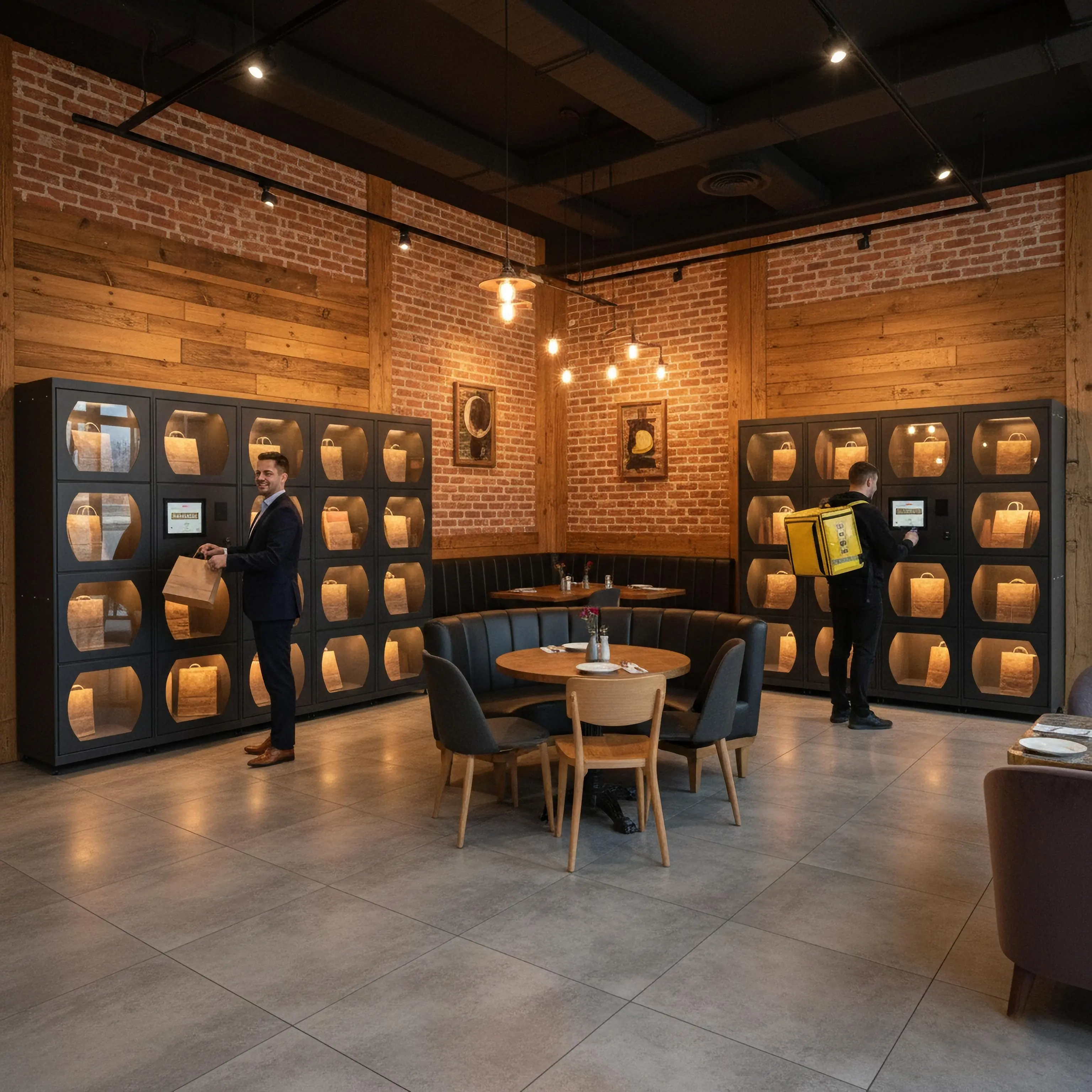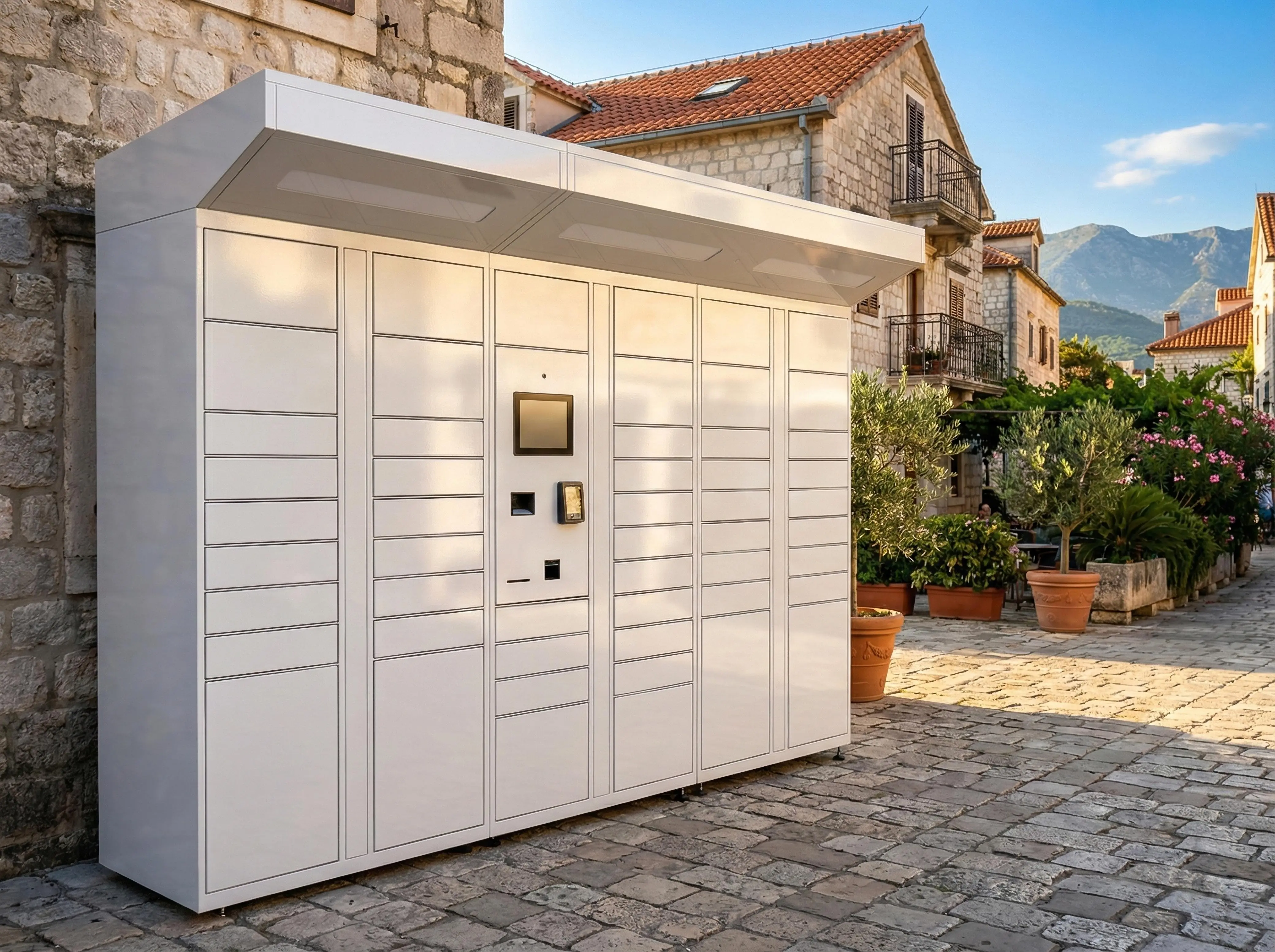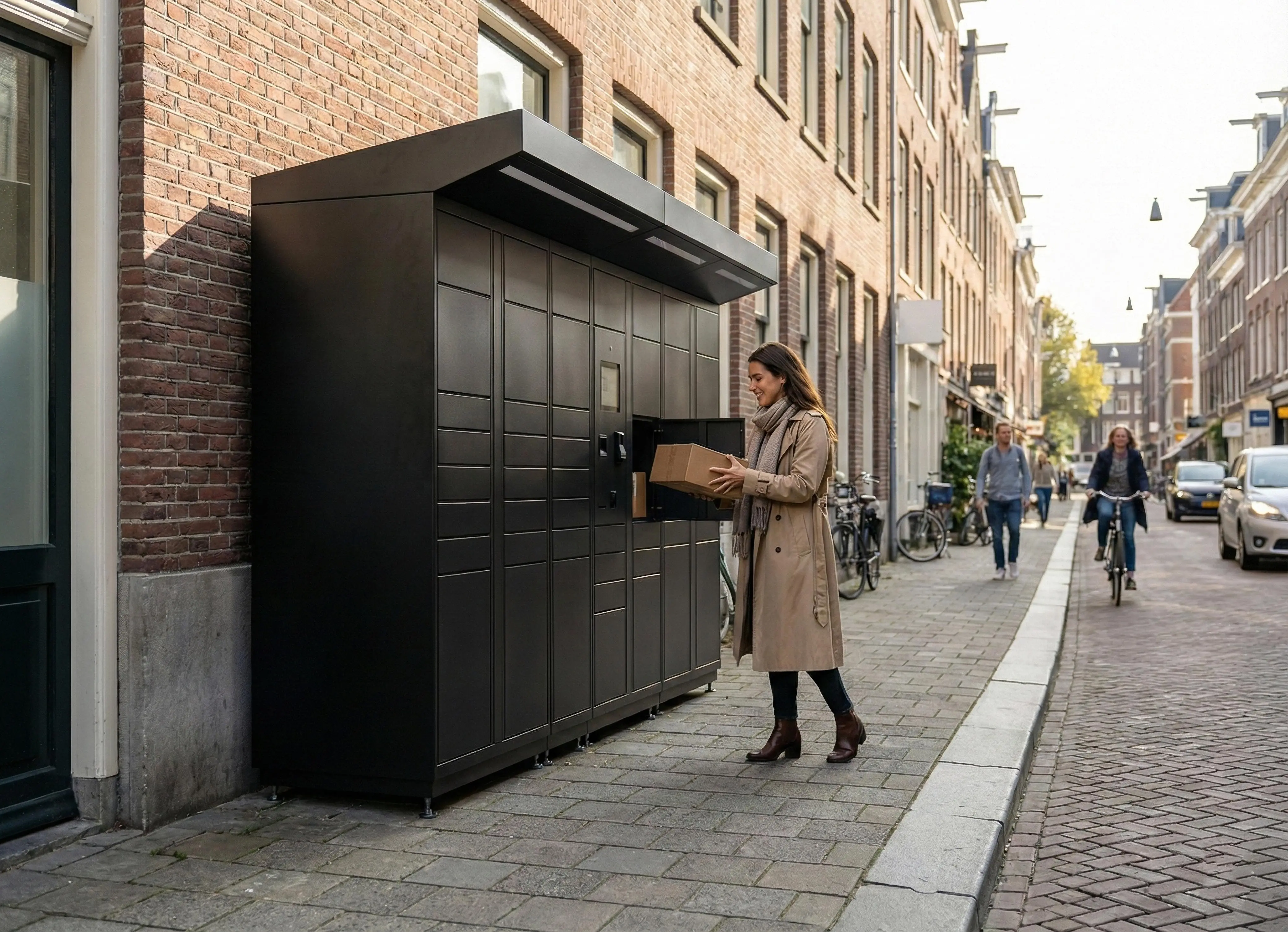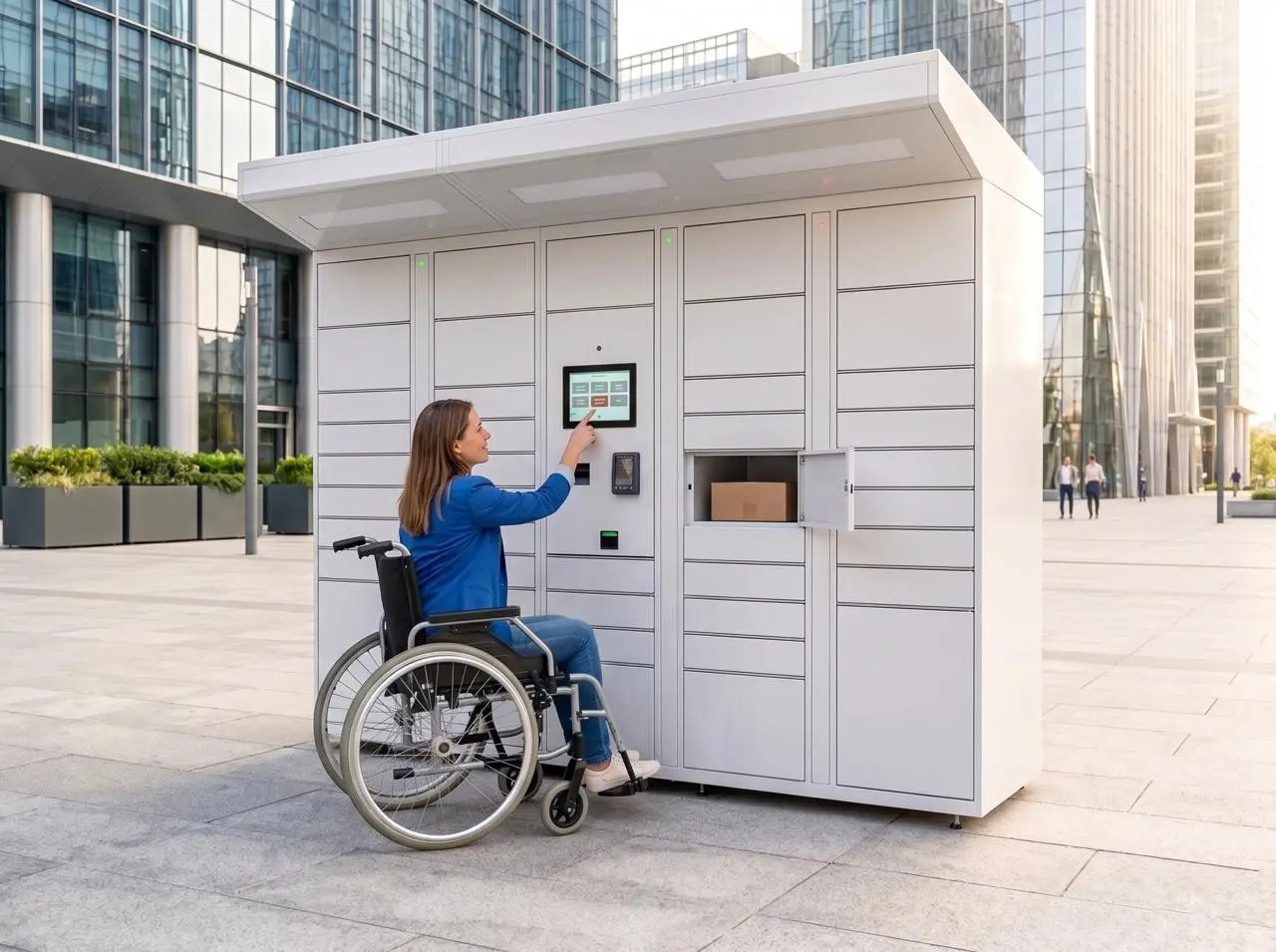
The European Accessibility Act (EAA) mandates that all parcel lockers placed on the market after June 28, 2025, must meet strict accessibility standards for users with disabilities. Parcel Hive parcel lockers and Cyber Hive™ Platform are designed to meet EAA and EN 301 549 accessibility requirements, providing operators with compliant infrastructure from deployment. Under Directive (EU) 2019/882, parcel lockers are classified as "interactive self-service terminals," requiring compliance with EN 301 549 technical specifications covering physical dimensions - including wheelchair-accessible reach heights of 380-1,220mm - audio guidance systems with text-to-speech, WCAG 2.1 Level AA visual interfaces, and comprehensive technical documentation. Non-compliance exposes operators to regulatory penalties and excludes nearly 87 million EU citizens with disabilities from using parcel locker networks.
This guide covers the engineering specifications, hardware positioning standards, software accessibility features, and documentation requirements that define EAA compliance for parcel locker systems. Whether deploying new networks or auditing existing installations, operators need precise technical standards to ensure their infrastructure serves all users while meeting European regulatory obligations.
Understanding the European Accessibility Act
The EAA classifies parcel lockers as "interactive self-service terminals" under Article 2(1)(b) of Directive (EU) 2019/882. This classification brings specific obligations that extend beyond basic usability into measurable technical standards defined by EN 301 549 - the harmonized European standard for ICT accessibility.
Key compliance dates operators must understand:
The regulation establishes three critical timelines. New parcel lockers placed on the market after June 28, 2025, require immediate compliance with all EAA requirements. Service providers operating non-compliant infrastructure have until June 28, 2030, to upgrade or phase out systems. Terminals installed before June 2025 receive an economic life exception, allowing operation until end-of-life with a maximum period of 20 years.
Technical compliance centers on EN 301 549 V3.2.1, the current version referenced in European harmonized standards. Clause 8 of this standard defines hardware requirements for stationary ICT - the category encompassing parcel lockers. A revision (V4.1.1) is expected in late 2026, though existing compliance with V3.2.1 provides a strong foundation for meeting updated requirements.
Enforcement mechanisms vary across member states. Some European markets have established graduated penalty structures. Lithuania's framework, for example, implements escalating fines based on violation severity and repetition. Initial non-compliance violations carry baseline penalties, ongoing violations after notification increase substantially, and cases where non-compliance causes demonstrable harm to users trigger the highest penalty tier. Other EU member states have adopted similar frameworks with jurisdiction-specific amounts.
The regulatory scope extends beyond hardware dimensions to encompass the complete user experience. Physical accessibility requirements address wheelchair users and individuals with limited reach or mobility. Visual accessibility provisions serve blind and low-vision users through audio alternatives and enhanced display standards. Auditory accessibility ensures deaf and hard-of-hearing users receive visual equivalents for all audio information. Motor accessibility accommodates users with limited dexterity through simplified controls and extended timeouts. Cognitive accessibility mandates clear language and intuitive interfaces for users with intellectual disabilities or language barriers.
Documentation requirements create audit trails. Manufacturers must prepare technical documentation per Annex IV of the Directive, demonstrating how their products meet accessibility requirements. This documentation must include design specifications, test results, user instructions in accessible formats, and installation guidance showing proper accessibility implementation. The EU Declaration of Conformity formalizes compliance claims and enables CE marking. Operators deploying compliant systems should retain copies of all manufacturer documentation as evidence of due diligence during regulatory inspections.
Parcel Hive systems include comprehensive EAA compliance documentation as standard - technical specifications per Annex IV, EU Declarations of Conformity with CE marking, installation manuals with dimensional accessibility drawings, and multi-format user instructions - providing operators with audit-ready compliance files from deployment.
Physical Accessibility: Reach Heights and Spatial Requirements
EN 301 549 Clause 8.3.2 establishes the fundamental requirement: all operable parts must fall within 380-1,220mm from floor level. This range reflects wheelchair user reach capabilities - 380mm marks the lower limit for forward reach without floor obstruction, while 1,220mm represents the upper boundary for comfortable seated access. Implementation determines whether compliance translates to genuine usability.
Parcel Hive positions all control elements within the 900-1,100mm universal reach zone, the height band where wheelchair users and standing adults both achieve comfortable access without strain. Analysis of Parcel Hive deployment data shows that centering touchscreens at 1,050mm reduces user errors compared to systems positioned at maximum allowable heights, while complaints about awkward positioning drop significantly. The engineering rationale extends beyond regulatory compliance: displays at 1,050mm place content at natural eye level for seated wheelchair users while remaining comfortably viewable for standing adults without requiring neck flexion.
Payment terminal positioning at 950mm allows contactless NFC interaction without users raising arms above heart level - reducing fatigue for elderly users and those with limited shoulder mobility. Receipt printer outputs at 900mm ensure printed receipts extend sufficiently for easy grasp without requiring users to reach into recessed compartments. Parcel Hive's component positioning strategy prioritizes the biomechanics of reach rather than simply meeting regulatory boundaries.
Depth considerations create additional complexity. EN 301 549 reduces maximum allowable heights when the control panel depth exceeds 510mm. For obstructions between 510-635mm deep, the maximum height drops to 1,120mm to account for reduced reach capability over deeper surfaces. Parcel Hive control panel designs maintain profiles under 480mm depth, preserving the full 380-1,220mm compliant range while accommodating internal component spacing for payment terminals, barcode scanners, and receipt printers.
Clear floor space requirements mandate a minimum 760mm width by 1,220mm depth - representing wheelchair footprint dimensions for frontal approach. Parcel Hive installation specifications recommend 900×1,300mm clearance zones, exceeding regulatory minimums by 18% to accommodate users approaching at angles or requiring additional maneuvering room. Field installation data revealed that sites with minimum clearances experienced higher user abandonment rates during peak periods when multiple users queue - the additional space prevents these accessibility bottlenecks.
Surface conditions amplify or undermine spatial requirements. Regulatory slope tolerance of 1:50 (2% grade) represents the maximum threshold, yet slopes approaching this limit challenge manual wheelchair users on smooth surfaces. Parcel Hive site evaluation guidelines recommend slopes under 1:100 where feasible and require slip-resistant surface treatments on any slope exceeding 1:150. The Cyber Hive™ Platform site assessment module guides operators through surface evaluation protocols, flagging installation locations where slopes, surface materials, or clearance dimensions fall outside accessibility recommendations.
Parcel Hive installation specifications include CAD drawings with accessibility zones highlighted, clearance measurements specified, and mounting height recommendations. These specifications reflect operational experience across diverse installation environments: indoor retail locations with controlled surfaces, outdoor transit stations with weather exposure, and mixed-use developments with varying pedestrian traffic patterns. Operators evaluating parcel locker systems should verify that manufacturer documentation includes dimensional accessibility specifications - see our guide to choosing accessible locker manufacturers for procurement criteria.
Accessible Compartment Design and Dynamic Allocation
Accessible compartments - those with door handles within 380-1,220mm reach range - typically include S and M sizes in the bottom three rows of standard configurations. Regulatory compliance requires these compartments to exist, but operational effectiveness depends on intelligent allocation logic that balances accessibility reservations against general inventory capacity.
The Cyber Hive™ Platform implements dynamic allocation algorithms rather than fixed percentage reservations. Analysis of operational patterns across Parcel Hive networks reveals that accessibility demand varies significantly by location type and time of day. Residential locations show morning peaks (elderly users, parents with strollers) compared to afternoon business district pickups. University campuses demonstrate different patterns than transit stations. Fixed 15% accessibility reservations create problems: overcommitment reduces capacity during low-demand periods, while undercommitment forces users with disabilities to travel to alternative locations during high-demand windows.
Parcel Hive's allocation logic analyzes temporal and demographic patterns to optimize per-location accessibility. The system adjusts reservations based on historical accessibility request frequency, e-commerce checkout flags, and real-time demand. When accessibility requests exceed available compartments at a selected location, the platform calculates alternatives considering not just distance but public transit accessibility, sidewalk conditions, and user-specific mobility constraints indicated in delivery preferences.
API integration creates the technical foundation for smart allocation. Cyber Hive™ Platform receives accessibility flags from e-commerce checkout systems (users indicate wheelchair use, visual impairment, or other accessibility needs), courier applications (drivers note delivery to accessible-only locations), and user profile databases (repeat customers with stored accessibility preferences). This multi-source data flow enables proactive allocation before users arrive at terminals.
Door handle mechanics present distinct engineering requirements beyond height positioning. Regulations mandate operation without tight grasping, pinching, or wrist twisting, with maximum force requirements of 22.2N. Parcel Hive compartment doors use lever handles requiring 18-20N operating force - providing a safety margin below regulatory limits while ensuring reliable latching mechanisms. Push-down lever operation accommodates one-hand use and functions for users wearing gloves or experiencing reduced grip strength from arthritis or other conditions.
Handle positioning within accessible compartments requires consideration beyond regulatory compliance. Testing protocols developed for Parcel Hive systems verify handle operation across diverse user populations: manual wheelchair users approaching from seated positions, users with limited shoulder range of motion, and individuals using mobility aids affecting stance and reach. Handles positioned at 600mm height (midpoint of S compartments) proved most universally accessible during field testing, while handles above 1,100mm showed declining usability for shorter wheelchair users even when technically within the 1,220mm maximum reach height.
Compartment door operation must account for the complete interaction sequence: approaching the compartment, grasping the handle, applying opening force, retrieving contents, and closing the door. Parcel Hive door mechanisms include assisted closing systems that require minimal force to engage latches - users simply push doors until magnetic catches align, eliminating the need for forceful slamming that challenges users with limited upper body strength. The integration between accessible hardware and intelligent software allocation demonstrates how EAA compliance requires coordinated physical and digital design.
Visual Accessibility: Display Standards and Audio Guidance
Text-to-speech requirements establish the foundation for blind user access to parcel locker systems. Hardware must include 3.5mm headphone jacks positioned within an accessible reach range, with tactile activation methods enabling users to initiate audio mode without visual navigation.
Parcel Hive integrates headphone jacks at 1,000mm height with raised ring tactile indicators, positioned adjacent to dedicated audio mode buttons featuring laser-etched Braille labeling. Privacy considerations drove headphone-only design: public speaker output exposes PIN codes and personal information in high-traffic environments. Field testing revealed user discomfort with audio announcements broadcasting transaction details in retail locations, transit stations, and residential lobbies.
The Cyber Hive™ Platform text-to-speech engine covers 24 European languages, guiding users through complete sequences: language selection with audio prompts, pickup code entry with digit-by-digit confirmation, compartment location using directional cues ("lower left section, compartment twelve"), and completion confirmation. Auto-activation when users connect headphones eliminates barriers requiring blind users to visually locate audio settings.
Display specifications require WCAG 2.1 Level AA compliance. Contrast ratios must achieve a minimum 4.5:1 for normal text and 3:1 for large text (18pt+). Parcel Hive interfaces implement 7:1 contrast ratios in standard mode - exceeding requirements by 55% to accommodate users with moderate vision impairment who experience difficulty with minimum-compliant interfaces. Enhanced contrast reduces transaction time and error rates across all user populations.
Cyber Hive™ Platform supports three display modes via single-tap toggle: standard mode (7:1 contrast, outdoor-optimized), high contrast mode (black background, white text, yellow highlights), and large text mode (18pt minimum, 1.5× line height). Users switch modes through an accessibility button marked with the universal access symbol - no menu navigation required.
Character height specifications mandate 6.1mm minimum at a 50cm viewing distance. Parcel Hive displays use 7.5mm character heights for primary content - 23% above minimums - reducing eye strain while maintaining appropriate information density. Secondary content uses 6.5mm heights, exceeding minimums while allowing efficient screen space utilization.
Viewing angle requirements address wheelchair user perspectives. Displays must remain readable from 1,015mm above the floor - typical seated eye height. Parcel Hive touchscreens use IPS panels with 178° viewing angles and anti-glare coatings, maintaining contrast ratios when viewed from 1,000mm at 45° angles representing wheelchair user positions. Standard TN panels fail to maintain adequate contrast at the required off-axis viewing angles.
Color cannot serve as the sole information carrier. Cyber Hive™ Platform combines color with redundant coding: errors show red text plus "X" icon plus descriptive message; confirmations display green plus checkmark plus completion text; interactive buttons use color plus raised appearance plus text labels. This ensures users with color vision deficiencies receive complete information through non-color channels.
For implementation guidance on visual accessibility features, see our smart locker pricing guide, which covers accessibility feature configurations.
Auditory and Motor Accessibility: Redundant Signaling and Control Design
Visual equivalents for audio signals form the foundation of auditory accessibility. Regulations mandate that every audio alert, notification, or instruction must have a corresponding visual representation - ensuring deaf and hard-of-hearing users receive identical information through non-auditory channels.
Parcel Hive compartment doors include tri-color LED indicators: blue signals ready state, green indicates door opening, red flags errors. On-screen animations reinforce these hardware signals - the interface pulses compartment numbers when opening, provides visual countdown timers, and displays confirmation checkmarks upon completion. Payment terminals integrate haptic feedback, vibrating on successful NFC tap to provide tactile confirmation independent of audio or visual channels.
Telecoil-compatible induction loops address users with hearing aids or cochlear implants. These systems create electromagnetic fields that assistive listening devices detect directly, eliminating background noise. Parcel Hive outdoor installations incorporate induction loops certified to EN 60118-4 standards, positioned near speaker zones to maximize field strength for users approaching terminals.
Motor accessibility requirements address control operation without tight grasping, pinching, or wrist twisting. Touchscreen button specifications establish 44×44 pixel minimums per WCAG 2.1 Success Criterion 2.5.5. Parcel Hive interfaces implement 48×48 pixel minimum button targets with 8-pixel spacing between interactive elements, providing error margin for users with hand tremors, limited fine motor control, or conditions affecting precision.
Touch sensitivity calibration significantly impacts motor accessibility. Screens requiring firm pressure create barriers for users with reduced hand strength. Parcel Hive touchscreens calibrate for light-touch activation, accommodating users with arthritis, elderly users with reduced grip strength, and individuals wearing gloves in outdoor installations. Capacitive touch technology enables this sensitivity while rejecting accidental activations from environmental contact.
Contactless NFC payment eliminates motor challenges associated with PIN entry. Precise digit selection presents difficulty for users with limited dexterity or visual-motor coordination challenges. Parcel Hive payment terminals prioritize NFC contactless operation, relegating PIN entry to fallback status. When PIN entry becomes necessary, the interface provides large button targets (20mm diameter minimum) with high-contrast visual feedback.
Extended timeout functionality addresses users requiring additional time for physical operations. Standard periods optimized for average users create barriers for individuals needing extra seconds to retrieve parcels, position wheelchairs, or coordinate movements affected by mobility conditions.
Cyber Hive™ Platform implements dynamic timeout extensions through clearly labeled "More Time" buttons on action screens. Each activation adds 30-second increments with unlimited availability - the system never forces completion within fixed timeframes. Timeout algorithms balance accessibility against security, maintaining door open durations adequate for users with disabilities while preventing extended unsecured states.
For specialized accessibility applications, see our temperature-controlled locker guide covering pharmaceutical delivery accessibility requirements.
Cognitive Accessibility: Language Simplification and Interface Logic
Language complexity requirements establish CEFR Level B2 as the maximum threshold for interface text - the intermediate proficiency level where most adults understand clear, direct information without specialized knowledge. This standard addresses users with intellectual disabilities, non-native speakers, elderly users experiencing cognitive changes, and individuals under stress processing complex language less effectively.
Parcel Hive interfaces apply plain language principles throughout user journeys. Error messages state "Code not recognized - please check your SMS and try again" rather than "Authentication failure: invalid credential format." Action prompts use "Enter your pickup code" instead of "Input delivery authentication token." This language simplification reduces cognitive load across all user populations while specifically addressing accessibility requirements.
Visual hierarchy principles structure information to minimize cognitive processing demands. Cyber Hive™ Platform interfaces present single actions per screen - users never encounter multi-step forms or compound decisions on one display. Progress indicators ("Step 2 of 4") provide orientation and reduce anxiety about process length. Primary action buttons appear consistently in bottom-right positions across screens, building muscle memory that reduces cognitive effort for locating next-step controls.
Icon and text dual coding leverages multiple cognitive pathways for information processing. Universal symbols (envelope for messages, clock for time, lock for security) pair with descriptive text labels on all interactive elements. Parcel Hive interfaces never rely on icons alone for critical functions - testing revealed symbol interpretation varies significantly across age groups, cultural backgrounds, and cognitive abilities. The combination ensures users struggling with abstract symbols can rely on text, while users with reading difficulties benefit from visual recognition.
Consistent layout patterns reduce cognitive mapping requirements. Cyber Hive™ Platform maintains identical positioning for recurring elements: accessibility controls always top-left, help functions top-right, primary actions bottom-right, and cancel options bottom-left. Users navigating multiple transactions develop spatial memory for control locations, reducing the cognitive overhead of visual search on each screen.
Error recovery design acknowledges that cognitive accessibility extends beyond preventing errors to supporting recovery when they occur. Vague messages like "Invalid input" force users into trial-and-error diagnosis - a cognitively demanding process. Parcel Hive error screens provide specific diagnostic information and recovery instructions: "This code expired 2 hours ago. Request a new code from the sender or contact support." This specificity eliminates ambiguity and provides clear action paths.
Timeout warning systems give users cognitive preparation for upcoming state changes. Cyber Hive™ Platform displays countdown timers during timed operations - "Door will close in 25 seconds" with a visual progress bar - allowing users to mentally prepare for completion or request extensions before automatic closure. Sudden timeouts without warning create stress and confusion, particularly for users with processing speed limitations.
Mobile application accessibility extends cognitive benefits through familiar smartphone interfaces. Users operating via mobile apps leverage existing device familiarity, personalized accessibility settings, and the ability to review instructions at their own pace before approaching physical terminals.
EAA Documentation Requirements and Compliance Evidence
Technical documentation requirements under Annex IV of Directive (EU) 2019/882 establish the evidentiary foundation for EAA compliance claims. Manufacturers must prepare comprehensive documentation demonstrating how their products meet accessibility requirements through design specifications, test results, user instructions, and installation guidance.
Annex IV documentation packages must include design specifications showing how hardware and software components address each accessibility requirement category: physical dimensions with dimensional drawings, audio guidance system architecture, display specifications with contrast measurements, motor accessibility features with force testing results, and cognitive accessibility through interface design documentation. This documentation serves dual purposes—internal design validation during development and external compliance verification during regulatory inspections or market surveillance activities.
Parcel Hive systems include complete Annex IV documentation packages as standard deliverables with every deployment. Technical specifications detail EN 301 549 compliance on a clause-by-clause basis, showing how each hardware component and software feature meets or exceeds regulatory requirements. Test results from third-party accessibility testing validate claims through independent verification rather than manufacturer self-certification alone.
EU Declaration of Conformity formalizes compliance claims and enables CE marking. This declaration must identify the manufacturer, describe the product, list applicable directives and harmonized standards, and include authorized signatory information. The EU Declaration provided with Parcel Hive deployments covers EAA compliance under Directive (EU) 2019/882, references EN 301 549 V3.2.1 as the applied harmonized standard, and includes all required manufacturer identification elements. Operators receive this documentation without requiring separate requests or additional documentation fees.
User instruction accessibility requirements extend beyond the locker system itself to the documentation describing system operation. Instructions must be available in formats accessible to users with disabilities - screen-reader compatible digital versions, large print options for users with low vision, and audio instructions for blind users.
Parcel Hive provides user instructions in multiple formats: tagged PDF files compatible with screen reader software, HTML versions optimized for browser accessibility features, large print PDF with 18pt minimum text size, and audio instructions accessible via QR codes displayed on physical terminals. This multi-format approach ensures users can access operational guidance through their preferred accessibility method without requiring special requests or accommodation processes.
Installation documentation must demonstrate proper accessibility implementation. Parcel Hive installation manuals include CAD drawings showing exact mounting heights for all operable elements, clear floor space dimensions with approach angles marked, surface condition requirements with slope tolerances specified, and lighting recommendations for users with visual impairments. These specifications enable installers to verify compliance during deployment and provide evidence for building accessibility inspections.
Retention requirements mandate manufacturers and operators maintain documentation for five years after products are placed on the market. This creates audit trails for regulatory authorities conducting market surveillance. Operators deploying compliant systems should retain complete documentation sets - manufacturer technical files, EU Declarations, installation verification records, and accessible user instructions - as evidence of due diligence.
For comprehensive guidance on accessible locker network deployment, see our last-mile delivery solutions guide, which addresses documentation requirements for various installation scenarios.
Deployment Strategies: New Networks and Existing Infrastructure
Operators face distinct implementation paths depending on whether they deploy new parcel locker networks or upgrade existing infrastructure to meet EAA requirements. New deployments benefit from specifying compliance upfront, while existing networks require systematic audits and phased retrofits or replacements.
New network deployment strategies begin with procurement specifications explicitly requiring EAA and EN 301 549 compliance. Request for Proposal documents should mandate the manufacturer's provision of complete Annex IV technical documentation, EU Declarations of Conformity, and accessible user instructions. Verification requirements should include dimensional drawings showing operating element heights, clear floor space specifications, and surface tolerances - ensuring manufacturers provide implementation-ready documentation rather than generic compliance claims.
Site evaluation criteria determine real-world accessibility regardless of hardware compliance. Parcel Hive site assessment protocols address surface conditions (level within 1:100 slope where possible, slip-resistant materials), lighting adequacy (minimum 200 lux for visually impaired users), weather protection (covered areas reduce slip hazards), and proximity to accessible transportation. Location selection affects accessibility outcomes as significantly as hardware specifications.
Existing network audits require systematic compliance gap assessment across installed terminals. Operators should measure operating element heights against 380-1,220mm requirements, verify clear floor space dimensions, test text-to-speech functionality, and evaluate display contrast ratios. Documentation review confirms whether manufacturer technical files and EU Declarations exist and remain valid. This audit identifies which terminals require minor retrofits versus complete replacement.
Prioritization frameworks guide retrofit sequencing when budgets prevent simultaneous network-wide upgrades. High-traffic locations serve the largest user populations and should receive priority - transit stations, shopping centers, residential complexes. Locations with legal accessibility mandates (government buildings, healthcare facilities) face obligations beyond EAA requirements and warrant early attention. Terminals approaching end-of-life present replacement opportunities where new compliant hardware proves more economical than retrofitting aging systems.
Phased implementation timelines must account for the June 28, 2030, deadline for service providers to upgrade non-compliant infrastructure. Operators managing large networks should develop multi-year replacement schedules rather than attempting simultaneous upgrades. Annual replacement of 15-20% of non-compliant terminals achieves full compliance within regulatory timeframes while distributing costs across budget cycles.
The Cyber Hive™ Platform's deployment management module assists operators in tracking compliance status across distributed networks. The system maintains compliance records per terminal (installation date, hardware model, accessibility features), flags terminals approaching the 2030 deadline, and generates compliance reporting for regulatory submissions. This centralized tracking prevents compliance gaps emerging when managing hundreds of terminals across multiple regions.
Budget allocation strategies should distinguish between capital expenditure for new compliant hardware and operational expenditure for software updates. Analysis of Parcel Hive network upgrades shows terminals deployed after 2020 typically require only software updates and minor hardware additions (headphone jacks, tactile buttons) to achieve full compliance, while older terminals often require complete replacement due to fundamental design limitations.
For operational guidance on deploying accessible networks, see our upgrade lab resources, which provide technical specifications and implementation timelines.
Conclusion: Accessible Parcel Locker Infrastructure
The European Accessibility Act establishes comprehensive accessibility standards for parcel locker systems, with compliance required for new deployments after June 28, 2025, and existing network upgrades mandated by June 28, 2030. Technical requirements span physical positioning (380-1,220mm reach ranges), audio guidance with text-to-speech, WCAG 2.1 Level AA visual interfaces, motor accessibility through simplified controls, cognitive accessibility via plain language design, and Annex IV compliance documentation.
Parcel Hive parcel lockers and Cyber Hive™ Platform are designed to meet EAA and EN 301 549 requirements through integrated accessibility engineering - from wheelchair-accessible control positioning and multi-language text-to-speech to intelligent compartment allocation and complete compliance documentation. Accessible infrastructure serves 87 million EU citizens with disabilities while benefiting all users through enhanced usability. For operators deploying parcel locker networks across Europe, contact our experts for EAA compliance consultation and deployment planning.
Frequently Asked Questions
When does EAA compliance become mandatory for parcel lockers?
What are the height requirements for accessible parcel lockers?
Are Parcel Hive lockers EAA compliant?
What accessibility features are required for visually impaired users?
How much clear floor space is required in front of parcel lockers?
What documentation is required to prove EAA compliance?
Do parcel lockers need accessible compartment allocation?
What are the penalties for EAA non-compliance?